

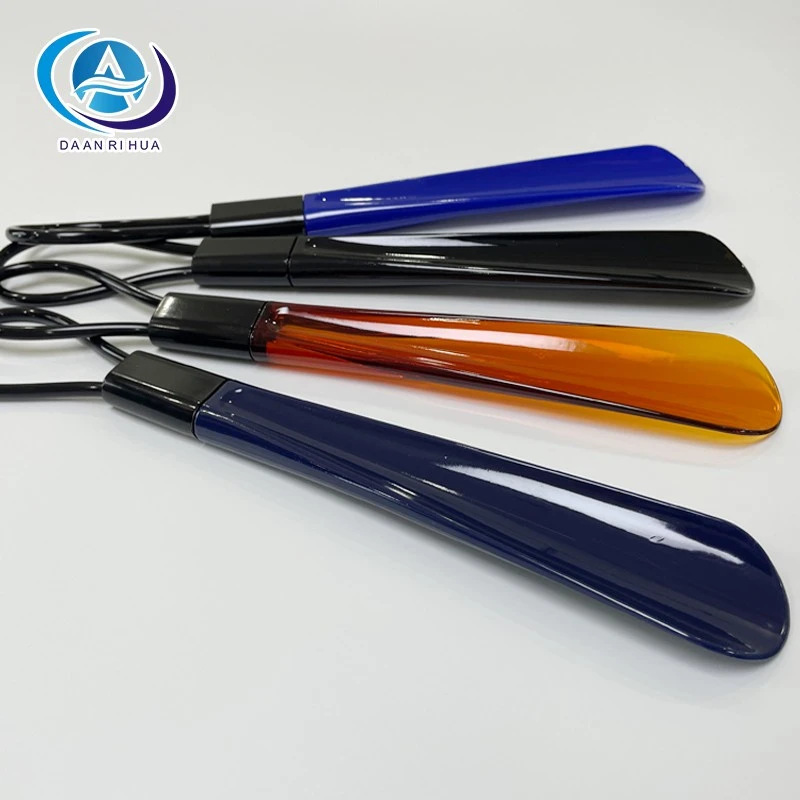
As a supplier of long handled shoe horns, I often get asked various questions about our products. One question that has been coming up more frequently lately is about the heat resistance of long handled shoe horns. In this blog post, I'll delve into this topic, exploring what heat resistance means in the context of long handled shoe horns, the factors that affect it, and why it matters.

Understanding Heat Resistance
Heat resistance refers to the ability of a material to withstand high temperatures without undergoing significant changes in its physical or chemical properties. For long handled shoe horns, heat resistance is crucial because they may be exposed to various temperature conditions during storage, transportation, and use.
When a shoe horn is exposed to high temperatures, it can experience a range of issues. For example, it may warp, lose its shape, or even become brittle. This not only affects the functionality of the shoe horn but also its aesthetic appeal. A warped shoe horn may not slide smoothly into the back of a shoe, making it difficult to use, while a brittle one may break easily.
Factors Affecting Heat Resistance
Several factors can influence the heat resistance of a long handled shoe horn. The most significant factor is the material from which the shoe horn is made.
Material Composition
- Plastic: Many long handled shoe horns are made from plastic due to its affordability and ease of manufacturing. However, different types of plastics have different heat resistance levels. For instance, polypropylene (PP) is a common plastic used in shoe horns. It has a relatively low melting point, typically around 160 - 170°C (320 - 338°F). This means that if exposed to temperatures close to or above this range, the plastic shoe horn may start to deform. On the other hand, polycarbonate (PC) is a more heat - resistant plastic, with a melting point of around 220 - 230°C (428 - 446°F). PC shoe horns can withstand higher temperatures without significant deformation.
- Metal: Metal shoe horns, such as those made from stainless steel or aluminum, generally have excellent heat resistance. Stainless steel has a melting point of around 1370 - 1530°C (2500 - 2790°F), while aluminum melts at approximately 660°C (1220°F). This makes metal shoe horns suitable for use in environments where they may be exposed to high temperatures, such as near heaters or in hot storage areas. You can find a variety of Metal Shoe Horns on our website.
- Wood: Wooden shoe horns are also popular. Wood has a relatively low heat resistance compared to metal. It can start to char or burn at temperatures around 200 - 250°C (392 - 482°F). Additionally, high heat can cause the wood to dry out and crack, reducing its durability.
Thickness and Design
The thickness of the shoe horn can also affect its heat resistance. A thicker shoe horn may be more resistant to heat as it takes longer for the heat to penetrate through the material. Similarly, the design of the shoe horn can play a role. A shoe horn with a more complex design or multiple layers may have different heat - transfer characteristics compared to a simple, single - layer design.
Why Heat Resistance Matters
Heat resistance is not just a technical specification; it has practical implications for both consumers and suppliers.
For Consumers
- Durability: A heat - resistant shoe horn will last longer. Consumers can use it in various environments without worrying about it getting damaged by heat. For example, if you live in a hot climate or store your shoes in a sunny area, a heat - resistant shoe horn will maintain its shape and functionality over time.
- Safety: Using a shoe horn with poor heat resistance in high - temperature environments can be dangerous. A plastic shoe horn that melts or deforms under heat may release harmful chemicals or sharp edges, posing a risk to the user.
For Suppliers
- Product Quality: Offering heat - resistant shoe horns enhances the overall quality of our products. This can lead to higher customer satisfaction and repeat business.
- Marketability: In a competitive market, heat resistance can be a unique selling point. It allows us to differentiate our products from those of our competitors and attract more customers. You can explore our High Quality Shoe Horn range, which includes options with good heat resistance.
Testing Heat Resistance
To ensure the heat resistance of our long handled shoe horns, we conduct rigorous testing. We use specialized equipment to expose the shoe horns to controlled high - temperature environments and monitor their performance.
We measure factors such as dimensional stability, changes in hardness, and visual appearance. For example, we may heat a plastic shoe horn to a specific temperature for a set period and then measure any changes in its length, width, or thickness. If the changes are within an acceptable range, the shoe horn passes the heat - resistance test.
Applications and Considerations
The heat resistance of long handled shoe horns makes them suitable for a variety of applications.
Industrial Use
In industrial settings, such as factories or warehouses, where temperatures can be high due to machinery or hot processes, metal shoe horns are ideal. They can withstand the heat and continue to function effectively, helping workers put on their shoes quickly and easily.
Home Use
At home, even though the temperature is usually more controlled, there are still situations where heat resistance is important. For example, if you store your shoes in a garage or attic that gets hot during the summer, a heat - resistant shoe horn will be a better choice.
Conclusion
In conclusion, the heat resistance of a long handled shoe horn is an important characteristic that depends on the material, thickness, and design of the shoe horn. Metal shoe horns generally offer the best heat resistance, followed by certain types of plastics and then wood.
As a supplier of long handled shoe horns, we are committed to providing high - quality products with excellent heat resistance. Our Long Handled Shoe Horn range includes options made from different materials to suit various customer needs.
If you are interested in purchasing long handled shoe horns or have any questions about our products, please feel free to contact us. We are more than happy to discuss your requirements and assist you in finding the perfect shoe horn for your needs.
References
- "Materials Science and Engineering: An Introduction" by William D. Callister Jr. and David G. Rethwisch.
- "Plastics Engineering Handbook" by Donald V. Rosato and Dominick V. Rosato.