

How Often Should You Polish Leather Shoes?
Leather shoes can last for years when they are cleaned, conditioned, and polished properly. However, one common question among both consumers and footwear businesses is: how often should you polish leather shoes?
For most regularly worn leather shoes, polishing every 2–4 weeks is a practical starting point. But there is no universal schedule. The right leather shoe polishing frequency depends on how often the shoes are worn, the type and condition of the leather, the environment, and the type of shoe polish being used.
For footwear retailers, shoe-care brands, distributors, and private-label buyers, understanding these factors is also important when selecting shoe care products for different customer groups.

How Often Should Leather Shoes Be Polished?
A useful general guideline is:
| Shoe Usage | Suggested Polishing Frequency |
|---|---|
| Daily or frequent wear | About every 1–2 weeks, depending on condition |
| Regular office wear | About every 2–4 weeks |
| Occasional wear | Before important use or when the finish looks dull |
| Formal shoes stored for long periods | Clean and inspect before polishing as needed |
| Shoes exposed to rain, dust, or harsh conditions | Inspect and care for them more frequently |
These intervals are guidelines rather than strict rules.
Instead of polishing simply because a certain number of days have passed, users should look at the condition of the leather. Loss of shine, visible scuffs, fading, and a dry-looking surface can all indicate that the shoes need attention.
What Determines How Often You Should Polish Leather Shoes?
1. How Often the Shoes Are Worn
Frequency of use is one of the biggest factors.
Shoes worn five days a week experience considerably more friction, dust, moisture, and surface wear than a pair worn twice a month.
Frequently worn business shoes may therefore need light maintenance every one or two weeks, while occasional dress shoes may go much longer between polishing sessions.
2. The Environment
Weather and working conditions also affect the maintenance schedule.
Leather footwear exposed to rain, road dust, mud, or other outdoor conditions generally requires more frequent cleaning and inspection. In contrast, shoes mainly worn in clean indoor environments may retain their appearance longer.
Polishing should not simply cover dirt. Surface contamination should be removed before polish is applied.
3. Leather Condition
The appearance of the leather is often more useful than a calendar.
Common signs that leather shoes may need care include:
- Loss of surface shine
- Minor scuffs and marks
- Uneven-looking color
- A dry or tired appearance
- Reduced visual depth in darker leather
However, polish is primarily intended to improve appearance and provide surface finishing. If the leather itself feels particularly dry, an appropriate leather conditioning step may also be necessary.

4. Type of Shoe Polish
Different shoe polish formats are designed for different maintenance needs.
Liquid shoe polish is convenient for quick shine and routine appearance maintenance. Products with integrated applicators can be especially useful for consumers who want a fast, simple process.
Cream shoe polish can be useful when users want controlled application and appearance maintenance, particularly where color refreshment is desired.
Wax or solid shoe polish is commonly chosen when users want a more traditional polishing process and a higher-gloss finish after buffing.
Because these formats serve different purposes, the appropriate application frequency can also vary.
Can You Polish Leather Shoes Too Often?
Yes. More frequent polishing does not automatically mean better leather care.
Applying unnecessary layers of polish without properly cleaning the surface can lead to product buildup. Depending on the formulation and application method, excessive product may create an uneven finish or make subsequent maintenance more difficult.
A better routine is:
- Remove loose dust and dirt.
- Check the condition of the leather.
- Clean the surface when necessary.
- Condition the leather if appropriate.
- Apply a suitable amount of polish.
- Allow the product to work according to its directions.
- Buff when required by the polish type.
The objective should be appropriate maintenance rather than maximum polishing frequency.
Should You Polish Shoes After Every Wear?
Usually, no.
For normal leather footwear, brushing or wiping away surface dust after wear is often sufficient. A full polishing process after every use is generally unnecessary.
There are exceptions. If footwear becomes noticeably dirty, wet, scuffed, or exposed to challenging conditions, it may need attention sooner than its normal maintenance schedule.
This distinction is useful for shoe-care brands when communicating product use. A product marketed for frequent convenience maintenance may require a different positioning strategy from a traditional polish intended for a more complete shoe-care routine.
A Practical Leather Shoe Care Routine
Polishing works best as one part of a broader maintenance process.
After Wearing
Remove obvious dirt and allow damp footwear to dry naturally before applying care products. Avoid applying polish directly over a dirty or wet surface.
Every Few Wears
Inspect the leather for dust, scuffs, dryness, fading, and loss of shine.
Light cleaning may be sufficient when the shoes still have a good finish.
Every 2–4 Weeks for Regularly Worn Shoes
For many users, this is a reasonable time to assess whether another polish application is necessary.
Shoes that still look clean and polished do not necessarily need another coat simply because several weeks have passed.
Periodically
Consider whether the leather needs conditioning rather than additional polish. Leather conditioner and shoe polish are not necessarily interchangeable products: conditioning focuses more on maintaining the leather, while polish is generally used for appearance, color enhancement, shine, and surface finishing.

How Much Shoe Polish Should You Apply?
Using more polish does not necessarily create more shine.
A thin, even application is usually preferable to a heavy layer. Excessive polish can take longer to work with and may contribute to buildup.
The exact application method depends on the product format.
For example, a liquid shoe polish with a sponge applicator may be applied directly across the surface, while a traditional cream or wax polish may be applied with a cloth, sponge, or brush and then buffed.
Buyers sourcing shoe polish should therefore evaluate not only the formulation category but also the application system and intended consumer experience.
Choosing Shoe Polish for Different Customer Needs
For importers, wholesalers, footwear brands, and private-label businesses, the question is not simply which polish produces shine. The product should match the intended market and usage scenario.
| Buyer Requirement | Product Type to Consider |
|---|---|
| Fast everyday appearance maintenance | Liquid shoe polish |
| Convenient direct application | Polish with integrated applicator |
| Traditional shoe-care routine | Cream or solid/wax polish |
| Color maintenance | Appropriate pigmented polish |
| Use across multiple leather colors | Neutral polish where suitable |
| Shoe-care gift or retail program | Multi-product shoe care kit |

Consider the Target Consumer
A convenience-focused customer may value fast application more than an intensive buffing process.
Professional footwear users may prioritize consistent appearance and easy routine maintenance.
Traditional shoe-care customers may prefer creams, waxes, brushes, cloths, and multi-step polishing routines.
These differences should influence product selection, packaging, instructions, and private-label positioning.
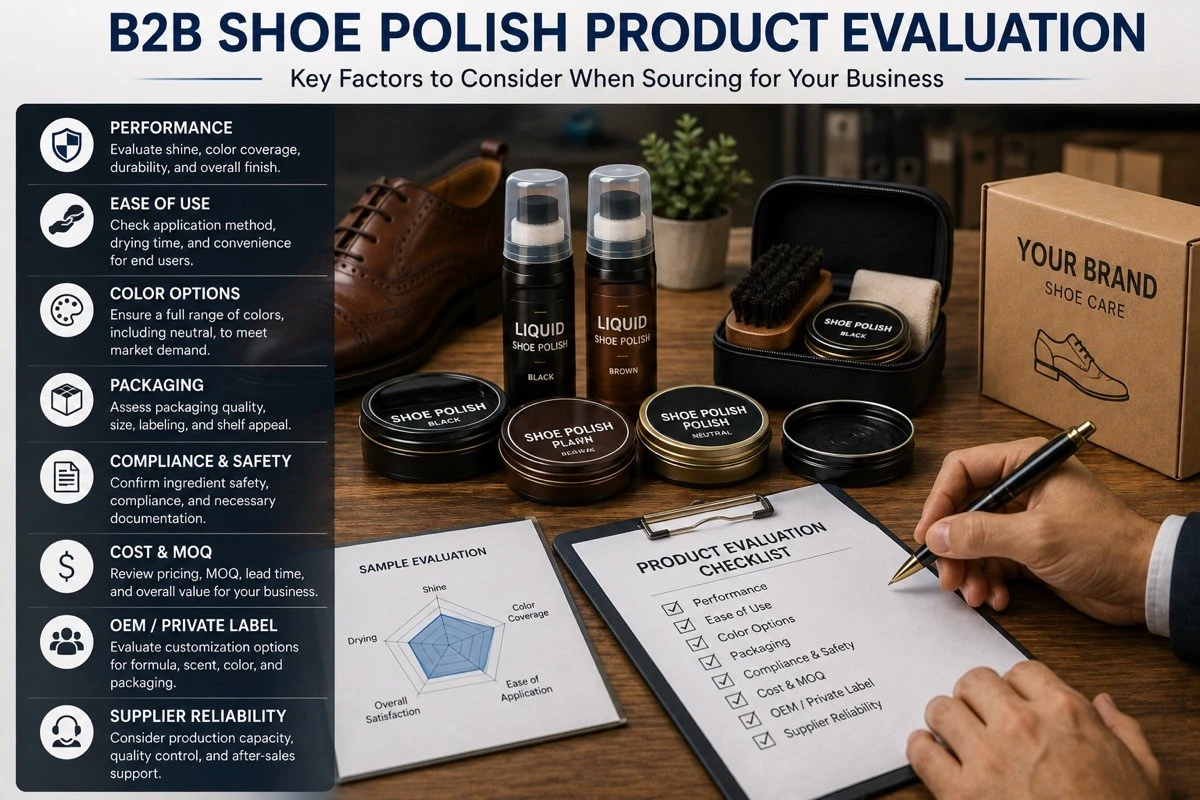
What Should B2B Buyers Evaluate When Sourcing Shoe Polish?
When sourcing shoe polish for wholesale, retail, or private-label programs, buyers should evaluate the product as a complete commercial solution rather than judging it only by initial shine.
Important considerations include:
- Intended leather type and application
- Polish format
- Application method
- Available color options
- Ease of use
- Finish after application
- Packaging suitability
- Product instructions
- Target retail positioning
- OEM or private-label requirements
Samples can be particularly useful when comparing products. Buyers can evaluate application behavior, finish, packaging usability, and compatibility with their target market before proceeding with a larger purchasing decision.
OEM and Private Label Shoe Polish Considerations
Different markets may require different shoe-care formats.
A brand targeting supermarkets may prioritize convenient application and consumer-friendly packaging. A traditional footwear retailer may prefer cream or solid polish products, while a shoe-care specialist may build a broader range covering cleaning, conditioning, polishing, brushes, and accessories.
For an OEM shoe polish or private label shoe polish project, buyers should communicate the intended product format, target consumer, application scenario, packaging concept, and market positioning to the supplier.
This makes it easier to determine which product direction is appropriate before discussing specific customization requirements.
Frequently Asked Questions
How often should I polish leather shoes if I wear them every day?
Frequently worn leather shoes can be inspected weekly and polished when their shine begins to fade or minor scuffs become visible. Depending on use and environment, this may mean approximately every one to two weeks.
Is polishing leather shoes once a month enough?
For many regularly worn shoes, monthly polishing can be sufficient. Shoes exposed to heavier wear, dust, moisture, or frequent outdoor use may require more frequent care.
Should I clean leather shoes before polishing them?
Yes. Loose dust and surface dirt should be removed before applying polish. Applying polish over a dirty surface can produce an uneven finish and contribute to buildup.
Can I use liquid shoe polish frequently?
Liquid polish can be suitable for routine appearance maintenance when used according to the product instructions. Avoid repeatedly adding unnecessary layers when the shoes do not need polishing.
Is shoe polish the same as leather conditioner?
No. They can serve different purposes. Shoe polish generally focuses on appearance, color, shine, and surface finishing, while leather conditioners are designed primarily to help maintain the leather itself.
Should new leather shoes be polished immediately?
Not necessarily. New shoes should first be evaluated based on their existing finish and the footwear manufacturer's care recommendations. Polishing may be useful when additional appearance maintenance is required.
How do I choose between black, brown, and neutral shoe polish?
Pigmented polish should be selected to suit the leather color. Neutral polish can be useful where additional pigment is not desired, although users should still confirm that the product is suitable for the specific leather and finish.
Conclusion
So, how often should you polish leather shoes? For regularly worn footwear, every two to four weeks is a useful general guideline, while frequently worn shoes may need attention sooner. The most reliable approach is to judge the actual condition of the leather rather than follow a rigid schedule.
For B2B buyers, polishing frequency also highlights an important sourcing principle: different consumers require different shoe-care solutions. Liquid, cream, solid, wax, and other formats can serve different maintenance habits, application preferences, and retail positions.
If you are sourcing shoe polish for wholesale, OEM, ODM, or private-label distribution, you can discuss your target market, preferred product format, packaging requirements, samples, and specifications with the supplier before selecting the appropriate solution.