

Common Mistakes When Using Liquid Shoe Polish
Liquid shoe polish is popular because it offers a fast and convenient way to improve the appearance of smooth leather shoes. With a built-in applicator or sponge, users can apply polish directly to the leather without preparing multiple shoe-care tools.
However, convenience does not mean every application produces the same result. Applying too much product, polishing dirty shoes, choosing an unsuitable color, or using liquid polish on the wrong material can lead to uneven appearance, residue, or disappointing results.
For importers, footwear brands, wholesalers, distributors, and private label shoe care buyers, understanding these common mistakes is also useful when selecting products, developing usage instructions, and planning an OEM liquid shoe polish range.
This guide explains the most common mistakes when using liquid shoe polish, how to avoid them, and what B2B buyers should consider when sourcing this type of shoe care product.

Mistake 1: Applying Liquid Shoe Polish to Dirty Shoes
One of the most common mistakes is applying polish directly over dust, mud, or other surface contamination.
Liquid shoe polish is designed to be applied to an appropriate leather surface. If dirt remains on the shoe, the applicator may spread it across the leather rather than creating a clean, even finish.
This can result in:
- Uneven coverage
- Visible streaks or patches
- Dirt becoming mixed with the polish
- A less attractive final appearance
- Contamination of the applicator sponge
Before polishing, remove loose dust and surface dirt with a suitable cloth or brush. If deeper cleaning is required, clean the shoes first and allow them to dry appropriately before applying polish.
For B2B buyers, simple preparation instructions on packaging can help end users understand that liquid polish is not necessarily a substitute for cleaning.
Mistake 2: Using Too Much Polish at Once
More polish does not automatically create more shine.
Applying a heavy layer can make the surface difficult to control and may leave excess product in seams, creases, decorative details, or around the sole edge.
A better approach is to apply a thin and even layer of liquid shoe polish, adding more only where necessary.
Why Thin Application Matters
A controlled application makes it easier to:
- Distribute the polish evenly
- Avoid excessive buildup
- Reduce visible streaking
- Control coverage around detailed areas
- Achieve a more consistent appearance
This is especially important for products with built-in sponge applicators because users may press the bottle too firmly and release more polish than required.

Mistake 3: Pressing the Sponge Applicator Too Hard
Many instant liquid shoe polish products combine the container and applicator into one package. This makes application convenient, but it also creates a common user error: excessive pressure.
Pressing too hard can release too much product or make application less uniform.
Instead, users should apply controlled pressure and move the applicator smoothly across the shoe surface.
The applicator design therefore matters not only for appearance but also for the user experience. For OEM and private label buyers, it is worth evaluating how easily the package dispenses the polish during actual use rather than judging the bottle only by its visual design.
Mistake 4: Using Liquid Shoe Polish on the Wrong Material
Not every shoe material should be treated with the same polish.
A liquid shoe polish intended for smooth leather should not automatically be used on suede, nubuck, fabric, mesh, or other materials unless the product is specifically designed and labeled for those surfaces.
Suede and nubuck, for example, have textured surfaces that require different care methods. Applying an unsuitable smooth-leather polish may alter their appearance.
Before application, users should identify both the shoe material and the intended use stated on the product.
| Shoe Material | General Product Selection Consideration |
|---|---|
| Smooth leather | Common application area for suitable liquid shoe polish |
| Suede | Usually requires suede-specific care products |
| Nubuck | Usually requires nubuck-compatible care products |
| Fabric or mesh | Use products specifically intended for the material |
| Synthetic materials | Check product suitability before application |
| Mixed-material shoes | Treat each material according to its individual requirements |
For distributors selling several shoe-care categories, clear differentiation between smooth leather polish, suede care, sneaker cleaning, and other products can reduce consumer confusion.
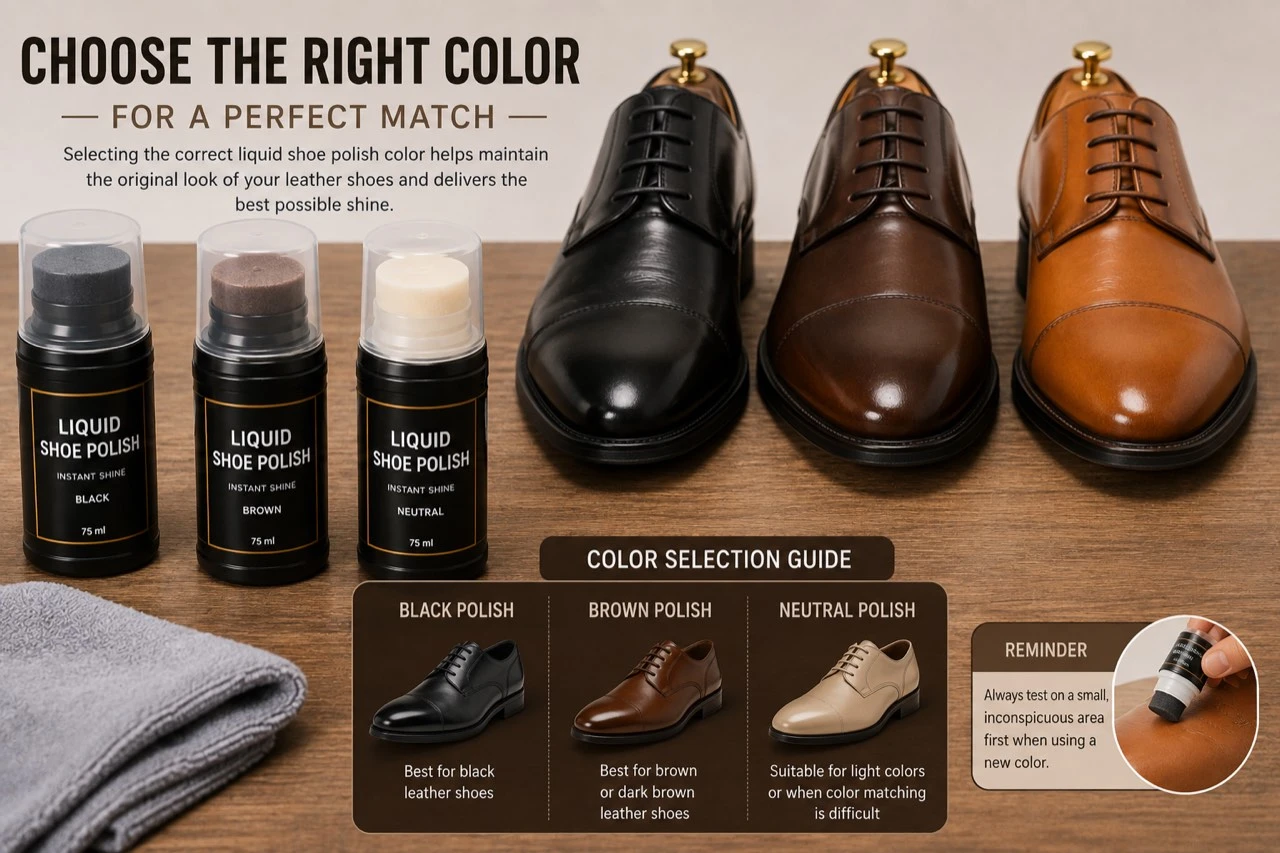
Mistake 5: Choosing the Wrong Polish Color
Color selection is another important consideration.
A colored liquid shoe polish should generally be matched appropriately to the shoe color. Using a significantly different shade can produce an unwanted appearance, particularly on lighter footwear.
Neutral polish may be useful when color matching is difficult, but neutral and colored polish should not automatically be treated as identical products. Their intended merchandising and consumer expectations can differ.
When testing a colored product for the first time, applying it to a small, less visible area is a sensible precaution.
Mistake 6: Expecting Liquid Polish to Repair Damaged Leather
Liquid shoe polish can improve appearance, but buyers and consumers should distinguish between polishing and repairing.
Deep scratches, cracks, peeling surfaces, severe discoloration, or structural leather damage cannot necessarily be solved by simply applying more polish.
Liquid polish is generally better understood as a convenient maintenance and appearance-care product rather than a universal leather restoration solution.
This distinction is particularly important for brands developing packaging claims. Usage instructions and product positioning should reflect the actual function of the formula instead of creating unrealistic expectations.
Mistake 7: Applying Multiple Heavy Layers to Faded Areas
When one area looks more faded than the rest of the shoe, users may repeatedly apply polish to that spot.
This can create an obvious difference between treated areas.
A better method is usually to work with controlled, thin applications and evaluate the appearance before adding another layer. If the leather is heavily faded or damaged, a different leather-care or recoloring solution may be more appropriate.
The goal should be consistent coverage rather than simply maximizing the amount of polish applied.
Mistake 8: Ignoring Seams, Edges, and Decorative Details
The large flat sections of a shoe are relatively easy to polish. Problems are more likely around:
- Stitching
- Seams
- Brogue perforations
- Decorative grooves
- Welt areas
- Sole edges
- Hardware and accessories
Excess liquid can collect in these areas.
Users should apply the product carefully around detailed sections instead of using the same pressure and amount across the entire shoe.

Mistake 9: Not Testing the Product Before Full Application
Leather shoes can vary in finish, color, surface treatment, and condition. Even when a product is intended for a particular category of leather, testing on a small inconspicuous area is a useful precaution.
This is especially relevant when:
- The shoe is light-colored
- The original finish is uncertain
- The leather has already been treated with other products
- A colored polish is being used for the first time
For private label brands, adding an appropriate test-area instruction can improve the clarity of consumer directions.
Mistake 10: Treating Every Liquid Shoe Polish as the Same
For B2B sourcing, one of the biggest mistakes is evaluating liquid shoe polish only by price or packaging appearance.
Products can differ in formula, application behavior, packaging, applicator design, color options, finish, and intended market positioning.
Importers and distributors should therefore evaluate the complete product experience.
What B2B Buyers Should Evaluate
| Evaluation Area | What to Check |
|---|---|
| Intended use | Suitable materials and application scenarios |
| Application | Ease and consistency of product distribution |
| Applicator | Sponge structure and practical usability |
| Appearance | Uniformity after application |
| Color | Suitability for the intended product range |
| Packaging | Convenience, presentation, and market positioning |
| Instructions | Clear directions and precautions for end users |
| Customization | Available OEM, ODM, or private label options |
| Documentation | Relevant product information available from the supplier |
Actual product samples should be evaluated before confirming a bulk order, especially when the product will be sold under a buyer's own brand.
How to Use Liquid Shoe Polish More Effectively
Although instructions should always follow the specific product, a typical application process for a suitable liquid shoe polish can be summarized as follows:
- Check that the shoe material is suitable for the product.
- Remove dust and visible surface dirt.
- Allow the surface to be appropriately dry before polishing.
- Test the polish on a small, inconspicuous area when necessary.
- Apply a thin, even layer with controlled pressure.
- Pay attention to seams, edges, and detailed areas.
- Allow the applied product to settle or dry according to its instructions.
- Evaluate the result before applying additional product.

Liquid Shoe Polish vs Traditional Shoe Polish
Some application mistakes occur because users expect liquid shoe polish to behave exactly like traditional wax or cream products.
These formats can serve overlapping shoe-care needs, but their application experience is different.
| Factor | Liquid Shoe Polish | Traditional Wax or Cream Polish |
|---|---|---|
| Application | Often applied directly with a built-in applicator | Usually requires a cloth, brush, or separate applicator |
| Convenience | High | More preparation may be required |
| Application control | Depends strongly on applicator and user pressure | User can control the amount with separate tools |
| Typical positioning | Quick maintenance and convenient polishing | Traditional or more involved shoe-care routines |
| Retail appeal | Convenient for everyday consumers | Familiar to traditional shoe-care users |
Neither format is automatically better for every market. The appropriate choice depends on the target customer, retail channel, expected application experience, and product positioning.
What Importers Should Consider When Sourcing Liquid Shoe Polish
For importers, wholesalers, and private label brands, reducing user mistakes starts before the product reaches the consumer.
Product selection, packaging design, and instructions all influence how easily customers can use the polish correctly.
Test the Complete Product, Not Just the Formula
A formula may perform differently depending on the applicator and packaging system.
When reviewing samples, test the complete package as the consumer would use it. Consider whether the applicator releases a controllable amount and whether the product can be distributed evenly.
Match the Product to the Target Market
Consider how customers are expected to use the product.
A convenience-oriented retail customer may prioritize fast application and simple instructions, while a professional shoe-care customer may expect different performance characteristics and application methods.
Make Usage Instructions Clear
Good packaging should help users understand:
- Suitable materials
- Basic preparation
- Application method
- Relevant precautions
- Color selection where applicable
- Storage or handling instructions required for the specific product
Clear instructions can reduce misuse and support a better consumer experience.
Evaluate OEM and Private Label Requirements
When sourcing OEM liquid shoe polish or developing a private label shoe polish, buyers should discuss their actual market requirements with the supplier rather than selecting a product based only on a reference sample.
Relevant discussions may include product positioning, packaging, branding, applicator format, color range, labeling requirements, and other customization possibilities available for the specific project.

Frequently Asked Questions
Can I apply liquid shoe polish without cleaning the shoes first?
Loose dust and surface dirt should generally be removed before polishing. Applying polish over a dirty surface can interfere with even application and may contaminate the applicator.
Can I use liquid shoe polish on suede or nubuck?
Do not assume that a liquid polish designed for smooth leather is suitable for suede or nubuck. These materials normally require products specifically intended for their textured surfaces.
Should I apply a thick layer of liquid shoe polish for more shine?
Not necessarily. A thin, controlled application is generally easier to distribute evenly. Excessive product may collect around seams and detailed areas.
Can liquid shoe polish fix badly faded or scratched leather?
Liquid polish may improve appearance, but severe fading, deep scratches, cracking, peeling, or other damage may require a different type of leather-care or restoration product.
How do I choose the right liquid shoe polish color?
Select a color appropriate for the footwear and consider testing it on a small, less visible area before treating the entire shoe. Neutral products may be an option when appropriate, but users should still follow the specific product instructions.
Why does liquid shoe polish sometimes look uneven?
Possible causes include applying it over dirt, using too much product, applying uneven pressure, choosing an unsuitable product for the material, or repeatedly treating only one area.
What should importers test before ordering private label liquid shoe polish?
Importers should evaluate the complete sample, including application behavior, applicator usability, appearance after use, packaging, instructions, and suitability for the intended market. Customization and documentation requirements should also be confirmed with the supplier.
Conclusion
Most problems with liquid shoe polish come from a few practical mistakes: applying it to an unsuitable or dirty surface, using excessive product, choosing the wrong color, applying uneven pressure, or expecting polish to repair damage it was not designed to fix.
For consumers, correct preparation and controlled application can make liquid shoe polish easier to use effectively. For importers, distributors, and private label brands, the same principles provide useful criteria for evaluating formulas, applicators, packaging, instructions, and overall product positioning.
If you are sourcing liquid shoe polish for wholesale, OEM, ODM, or private label distribution, discuss your target market, product requirements, packaging needs, and sample evaluation criteria before confirming a bulk order.