

Liquid shoe polish has become one of the most convenient leather care products for both consumers and commercial buyers. Unlike traditional wax polish that requires buffing, liquid shoe polish provides instant color restoration and shine with minimal effort. But how does liquid shoe polish actually work? What ingredients make it effective, and why has it become one of the most popular products for private label and OEM shoe care brands?
In this guide, we'll explain the science behind liquid shoe polish, how it interacts with leather, and why it remains a preferred solution for manufacturers, wholesalers, distributors, and global brands looking to expand their leather care product lines.
What Is Liquid Shoe Polish?
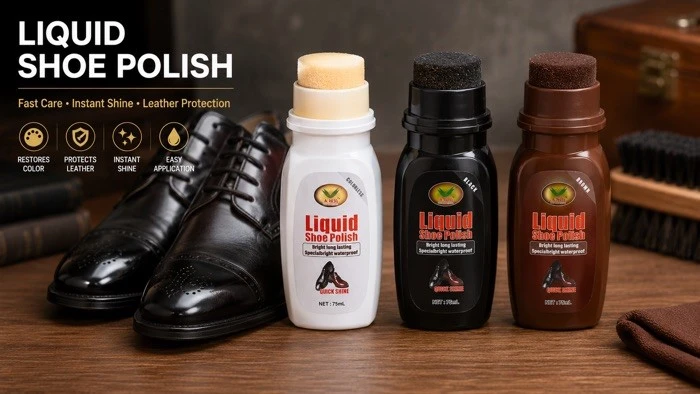
Liquid shoe polish is a fast-acting leather care product designed to restore color, enhance shine, and protect smooth leather surfaces. It combines pigments, waxes, solvents, conditioning agents, and silicone emulsions into a liquid formula that can be applied quickly using a built-in sponge applicator or soft cloth.
Compared with traditional wax polish, liquid shoe polish requires much less effort. There is usually no need for extensive buffing, making it ideal for daily leather shoe maintenance.
| Feature | Liquid Shoe Polish | Traditional Wax Polish |
|---|---|---|
| Application | Built-in sponge applicator | Cloth or brush |
| Drying Time | 1–3 minutes | 10–20 minutes |
| Buffing Required | Usually No | Yes |
| Color Restoration | Excellent | Excellent |
| Daily Maintenance | Excellent | Good |
| Travel Friendly | Very Good | Moderate |
How Does Liquid Shoe Polish Work?
Although the application process appears simple, liquid shoe polish performs several functions simultaneously. Once applied to leather, different ingredients work together to restore appearance while protecting the surface.
Step 1: The Liquid Formula Spreads Evenly Across the Leather
When the sponge applicator contacts the leather, a controlled amount of polish is released. The liquid consistency allows the polish to spread evenly over the leather grain, ensuring consistent coverage without excessive buildup.
This even distribution is especially important for restoring faded leather shoes that have uneven color caused by daily wear.
Step 2: Pigments Restore the Original Leather Color
One of the most important components of liquid shoe polish is its pigment system.
Over time, leather gradually loses its original color due to sunlight, friction, dust, and moisture. Fine pigments suspended inside the polish settle into microscopic scratches and worn areas, helping restore a richer, more uniform appearance.
Depending on the formula, manufacturers may offer:
Black liquid shoe polish
Brown liquid shoe polish
Neutral liquid shoe polish
Custom colors for OEM projects
For OEM and private label customers, pigment concentration can often be adjusted according to target markets and customer preferences.
Step 3: Waxes Form a Protective Layer
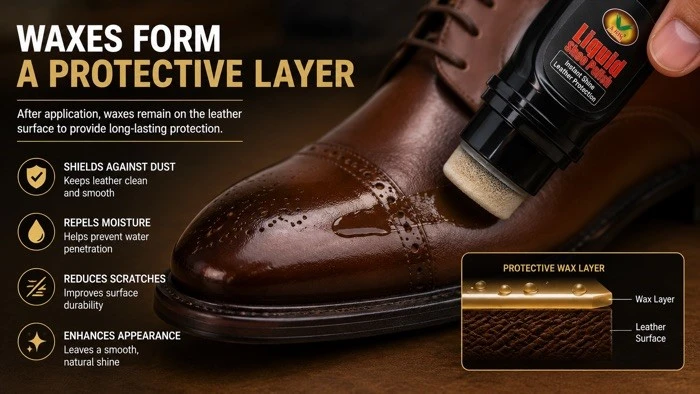
After application, the solvent begins to evaporate. As it disappears, natural or synthetic waxes remain on the leather surface.
This wax layer provides several important benefits:
Protects against dust accumulation
Reduces water penetration
Improves scratch resistance
Creates a smoother leather surface
Extends the life of leather footwear
Unlike thick traditional wax coatings, liquid shoe polish leaves behind a thinner protective film that preserves the natural flexibility of leather.
Step 4: Silicone Enhances Instant Shine
Many premium liquid shoe polish formulas include silicone emulsions. Silicone helps reflect light more evenly across the leather surface, creating the glossy finish that users notice immediately after application.
This explains why liquid shoe polish often delivers an instant shine without requiring heavy brushing or polishing.
Manufacturers can adjust silicone content depending on customer requirements, allowing brands to offer either a high-gloss finish or a more natural satin appearance.
Step 5: Conditioning Agents Help Maintain Leather Flexibility
Leather naturally loses moisture over time. Continuous exposure to dry environments can make leather stiff and prone to cracking.
Many liquid shoe polish formulations therefore include conditioning ingredients that help maintain softness while reducing moisture loss.
Although liquid shoe polish is not a deep leather conditioner, regular application contributes to healthier-looking leather by reducing everyday wear.
Main Ingredients Found in Liquid Shoe Polish

The exact formula varies between manufacturers, but most professional liquid shoe polish products contain the following components:
| Ingredient | Primary Function |
|---|---|
| Pigments | Restore leather color |
| Natural or Synthetic Wax | Create protective coating |
| Silicone Emulsion | Increase gloss and water resistance |
| Solvent or Water Base | Carry active ingredients evenly |
| Conditioning Agents | Maintain leather flexibility |
| Stabilizers | Maintain product consistency during storage |
Why Does Liquid Shoe Polish Dry So Quickly?
One reason for the popularity of liquid shoe polish is its fast drying speed. After application, volatile carriers evaporate quickly, allowing pigments and waxes to remain attached to the leather surface.
Under normal room temperature conditions, most liquid shoe polish products become touch-dry within one to three minutes.
This fast-drying characteristic makes liquid shoe polish particularly suitable for:
Business professionals
Hotel housekeeping
Airline shoe care kits
Military footwear maintenance
Retail shoe care products
Daily home leather care
Why Is Liquid Shoe Polish Ideal for OEM and Private Label Brands?
From a manufacturing perspective, liquid shoe polish is one of the most flexible leather care products for OEM and private label production.
Its formula, packaging, color options, fragrance, viscosity, and applicator design can all be customized according to different market requirements.
For importers, wholesalers, and retail brands, this flexibility creates opportunities to develop differentiated products without investing in their own manufacturing facilities.
How Is Liquid Shoe Polish Manufactured?

Professional liquid shoe polish production requires strict quality control throughout every manufacturing stage. An experienced OEM factory follows standardized procedures to ensure consistent color, viscosity, stability, and performance.
Raw Material Selection
High-quality raw materials are the foundation of reliable shoe polish. Manufacturers carefully select pigments, waxes, emulsifiers, conditioning agents, solvents, and preservatives to achieve the desired balance between shine, durability, and ease of application.
Formula Mixing and Emulsification
The ingredients are mixed under controlled temperatures using industrial mixing equipment. During this process, pigments are evenly dispersed, waxes are emulsified, and the liquid reaches a stable consistency suitable for long-term storage.
Quality Inspection
Before filling, every production batch is tested for key quality indicators, including:
Color consistency
Viscosity
Drying performance
Gloss level
Application smoothness
Storage stability
Filling and Packaging
The finished liquid shoe polish is automatically filled into bottles or sponge applicator containers. OEM manufacturers can provide various packaging solutions, including:
Sponge applicator bottles
Brush applicator bottles
Travel-size packaging
Retail gift sets
Private label packaging
Customized carton printing
Liquid Shoe Polish vs Traditional Wax Polish
Both liquid shoe polish and traditional wax polish protect leather, but they are designed for different maintenance needs.
| Comparison | Liquid Shoe Polish | Wax Polish |
|---|---|---|
| Application Speed | Very Fast | Slower |
| Instant Shine | Excellent | Moderate |
| Deep Nourishment | Moderate | Excellent |
| Buffing Required | No | Yes |
| Daily Maintenance | Excellent | Good |
| Professional Leather Restoration | Good | Excellent |
Many distributors choose to offer both products, allowing customers to use liquid shoe polish for routine maintenance while reserving wax polish for deep leather restoration.
How to Apply Liquid Shoe Polish Correctly
Using liquid shoe polish properly helps achieve the best appearance while extending the life of leather shoes.
Remove dust and dirt with a soft cloth.
Shake the bottle gently before use.
Press the sponge applicator lightly against the leather.
Apply a thin, even layer over the entire surface.
Allow the polish to dry naturally for one to three minutes.
Repeat only if additional color restoration is needed.
Applying multiple thin layers generally produces a more natural finish than applying one thick coat.
Common Mistakes to Avoid
| Mistake | Recommended Solution |
|---|---|
| Applying on dirty leather | Clean the shoes before polishing. |
| Using too much polish | Apply thin, even layers. |
| Using the wrong color | Select black, brown, neutral, or the correct matching shade. |
| Using on suede or nubuck | Only use on smooth leather unless specifically formulated otherwise. |
| Ignoring drying time | Allow the polish to dry completely before wearing the shoes. |
Choosing an OEM Liquid Shoe Polish Manufacturer

If you plan to develop your own shoe care brand, selecting the right manufacturing partner is just as important as choosing the right formula.
A professional OEM factory should be able to provide:
Stable product quality
Flexible MOQ options
Custom formulations
Private label packaging
Export experience
Product safety documentation
Working with an experienced manufacturer helps ensure product consistency while reducing development time for new brands.
Frequently Asked Questions
1. Does liquid shoe polish damage leather?
No. When formulated correctly and used on smooth leather, liquid shoe polish helps protect the leather surface while restoring color and shine.
2. How often should I apply liquid shoe polish?
For shoes worn regularly, applying liquid shoe polish every one to two weeks is generally sufficient. The exact frequency depends on usage and environmental conditions.
3. Can liquid shoe polish replace traditional wax polish?
Liquid shoe polish is excellent for everyday maintenance and quick touch-ups. Traditional wax polish remains the better choice for deep conditioning and achieving a high-gloss mirror finish.
4. Is liquid shoe polish waterproof?
Most liquid shoe polish formulas provide a degree of water resistance by creating a protective surface layer, but they are not a substitute for dedicated waterproofing products.
5. Can OEM manufacturers customize liquid shoe polish?
Yes. Professional manufacturers commonly offer OEM and private label services, including customized formulas, colors, fragrances, bottle designs, labels, and packaging.
Ready to Develop Your Own Liquid Shoe Polish Brand?
Whether you are a wholesaler, importer, distributor, or brand owner, choosing the right OEM manufacturing partner can make a significant difference in product quality and market success.
An experienced factory can support every stage of your project-from formula development and packaging design to mass production and international export-helping you launch competitive leather care products with confidence.
Looking for a reliable OEM liquid shoe polish manufacturer?
Contact our team today to discuss your private label requirements, request product samples, or receive a customized quotation. We provide flexible OEM/ODM solutions for customers worldwide.
Conclusion
Liquid shoe polish works by combining pigments, protective waxes, conditioning ingredients, and shine-enhancing agents into a fast-drying formula that restores the appearance of smooth leather while adding a protective coating.
Its convenience, quick application, and flexible customization options have made it one of the most popular leather care products in global markets. For wholesalers, distributors, and private label brands, partnering with an experienced OEM manufacturer offers the opportunity to deliver high-quality shoe care products tailored to specific customer needs.